Arctic Infrastructure Fund (Stream 2) — Application deadline: June 5, 2026
The Canadian
Path.
Longevity. Safety. Humanitarianism. Environmental Leadership.
One sovereign building system that reduces Canada's dependence on fossil fuels, answers the housing crisis, and positions this nation as the global leader it is becoming. This is not a product pitch. It is a path.
It's About Energy.
Strip away the engineering specifications, the fiscal multipliers, the defence applications, and the trade agreements. At its core, the Vox Block system does one thing: it reduces the amount of energy a building needs to exist.
A conventional wood-frame house in Manitoba consumes between 120 and 180 GJ of natural gas per year just to stay warm. That is fossil fuel, burned, every winter, for the 25 to 30 years the structure manages to hold together before it needs major renovation or replacement. A Vox Block structure — the same square footage, the same climate — reduces that consumption by 75 to 90 percent. Not through complex mechanical systems. Through the wall itself. The thermal mass of the minerite matrix absorbs, stores, and releases heat so slowly that the building barely needs a furnace.
Now multiply that across every home, every school, every hospital, every barracks, every office building, every long-term care facility in this country. The numbers become staggering. Canada's building stock is responsible for 18% of our national greenhouse gas emissions — 130 megatonnes of CO₂ equivalent per year. The single largest lever we have to reduce that number is not solar panels or heat pumps or carbon taxes. It is the thermal envelope of the building itself.If the walls don't leak heat, you don't need to burn fuel to replace it.
This is not a theoretical argument. It is physics. And it is the foundation of everything that follows on this page — the economic case, the humanitarian case, the sovereignty case, and the invitation we are extending to every Canadian who understands what is at stake.
A Vox Block home is a home. A school. A hospital. A place of business. A place of healing. A place of study. A place of security. But above all, it is a structure that stops asking the grid for energy it doesn't need. In a country where heating is not optional, where winter is six months long, and where every cubic metre of natural gas burned is a cubic metre we can never get back — that is not a feature. It is a national imperative.
From Farmer to Family.
Every link in this chain is Canadian. Every step reduces emissions. Every participant benefits. This is not a supply chain — it is a circle, and it begins in the soil.
The Farmer
Indigenous and settler farmers grow industrial hemp on marginal prairie land. The crop requires no pesticides, minimal water, and matures in 90 days. While it grows, each acre absorbs 10–15 tonnes of CO₂ from the atmosphere — more than any commercial crop on earth. The farmer earns income from a rotation crop that actually improves soil health for the next season. The hurd — the woody inner core — is what we need.
The Quarry
Manitoba sits on one of the richest limestone deposits in North America. The lime is quarried locally — no ocean shipping, no foreign dependency. It is calcined into the mineral binder that gives the Vox Block its extraordinary hardness, fire resistance, and century-scale durability. The quarry employs local workers and pays local taxes. The material travels less than 200 kilometres to the factory.
The Factory
This is where the circle meets industry. The hemp hurd and mineral binder are combined in a precision manufacturing process that produces interlocking blocks. The curing process requires heat — and this is where our strategic partnerships with carbon and heat emitters become critical. Industrial facilities that currently vent waste heat into the atmosphere can redirect it into our curing chambers. Their waste becomes our input. Their emission liability becomes our manufacturing energy. The factory produces 1,000 shipping containers of blocks per year — enough for 2,600 homes annually.
The Container
The blocks are designed to the exact dimensions of a standard 40-foot shipping container. This is not an accident — it is the core of the intermodal thesis. One container holds 3,240 blocks — enough for 2 to 3 complete homes. The container moves from factory to rail to ship to site without ever being unpacked. CentrePort Canada connects directly to CN and CP rail, to the Port of Churchill for Arctic and European routes, and to Thunder Bay for Great Lakes shipping. The same container that delivers blocks to a Manitoba reserve can deliver them to a NATO ally in Northern Europe.
The Builder
The interlocking block system requires no specialized trades. A crew of four can erect the structural walls of a 1,200 square foot home in days, not months. No mortar. No heavy equipment. No waste. The blocks lock together like a three-dimensional puzzle — each one keyed to the next. This means remote communities, Indigenous reserves, and northern settlements can build with local labour. The skill barrier that keeps housing costs high and construction timelines long is fundamentally lowered.
The Family
A family moves into a home that will outlast their grandchildren. It is fireproof. It is mould-proof. It is nearly silent inside. It costs a fraction of a conventional home to heat. It will never need new siding, never need a new roof structure, never rot, never burn. The mortgage is backed by collateral that appreciates rather than depreciates. The family builds equity from day one. Their children grow up in a home that is safe, warm, and permanent. This is what housing was supposed to be.
Your Emissions.
Our Energy.
We are actively seeking partnerships with industries that produce carbon emissions and waste heat. Not to criticize them — to help them. The Vox Block curing process requires thermal energy. If your facility vents heat into the atmosphere, that heat can cure our blocks instead. Your waste stream becomes our manufacturing input. Your emission liability becomes our shared solution.
This is not carbon offsetting through distant tree planting. This is direct, measurable, local industrial symbiosis — the kind of partnership that regulators, investors, and communities can see and verify.
Power Generation
Natural gas and biomass power plants produce enormous waste heat. Co-locating a Vox Block curing facility near a generation station turns thermal exhaust into building materials. The plant gains carbon offset credits. We gain curing energy at near-zero cost.
Cement & Concrete
Cement production is one of the highest-emitting industrial processes in Canada. Cement producers can partner with us to redirect kiln exhaust heat into block curing, while the Vox Block system itself reduces demand for conventional concrete — creating a managed transition pathway.
Steel & Smelting
Steel mills and smelters operate at temperatures far above what our curing process requires. Even their low-grade waste heat is more than sufficient. A partnership means their environmental compliance costs drop while housing materials are produced next door.
Oil & Gas Processing
Refineries and processing facilities across Western Canada produce continuous waste heat. Rather than fighting the energy sector, we propose working with it — converting their thermal byproduct into the walls of Canadian homes.
Municipal Waste-to-Energy
Cities that operate waste-to-energy incinerators can co-locate block curing facilities, turning municipal waste processing into a dual-output system: electricity for the grid and heat for housing materials.
Data Centres
The fastest-growing source of industrial heat in Canada. Data centres in Manitoba already benefit from cold-climate cooling advantages. Their exhaust heat, currently vented, can be captured for block curing — turning digital infrastructure into physical infrastructure.
"We are not asking polluters to stop producing. We are asking them to let us use what they are already wasting. Every joule of heat that currently escapes into the atmosphere is a joule that could be curing a wall for a Canadian family. This is pragmatic environmentalism — not ideology, but engineering."
Life in a Vox Block Home.
The national thesis, the industrial partnerships, the grant applications — they all exist to serve one outcome: a Canadian family living in a home that gives them their financial life back. Here is what that actually looks like.
The $4,000 Annual Raise
A conventional wood-frame house in Manitoba costs between $300 and $400 per month to heat and cool. That is $3,600 to $4,800 per year — money that leaves the family's pocket, flows to the utility company, and never comes back. It is not discretionary spending. It is survival spending. And it goes up every year.
A Vox Block home compresses that energy burden to $35 to $85 per month. The thermal mass of the minerite matrix holds heat so effectively that the building barely asks the grid for anything. That difference — $265 to $315 every single month — is not a rebate cheque that arrives once. It is permanent. It is immune to utility rate hikes. It is immune to inflation. It is money that stays in the family's hands, every month, for the life of the home.
Over a year, that is $3,000 to $4,000 in recovered income. Over a decade, it is $30,000 to $40,000. Over the 100-year life of the structure, the cumulative savings exceed the original cost of the home itself. This is not a marketing claim. It is thermodynamics.
Children's Education
$4,000 per year invested in an RESP from birth to age 18 grows to over $100,000 — enough to fund a full university degree. The home pays for the education.
Mortgage Acceleration
Redirecting $300/month to mortgage principal cuts a 25-year amortization to under 18 years. The family owns their home outright while their neighbours are still paying.
Retirement Security
$4,000 per year into an RRSP over a 30-year career, compounded, builds a retirement fund exceeding $300,000 — from money that would have gone to the gas company.
Emergency Resilience
A family with $300 more per month has a financial buffer against job loss, medical expenses, or unexpected costs. They are no longer one bad month away from crisis.
Selling Power Back to the Grid
Because the Vox Block home uses so little energy, something remarkable happens when you add solar panels to the roof: the home generates more electricity than it consumes.
Manitoba Hydro's Net Metering Program allows homeowners to sell excess electricity back to the grid. In a conventional wood-frame house, solar panels struggle to offset the enormous heating demand — the house consumes everything the panels produce and still needs more. In a Vox Block home, the thermal envelope is so efficient that the solar array has surplus capacity for most of the year.
The homeowner goes from paying $350/month to receiving a credit from the utility. The home is no longer a cost centre — it is a revenue-generating asset. The family is no longer a consumer of energy. They are a producer. Their home feeds the grid, and the grid pays them for it.
This is not a future technology. Net metering exists today. Solar panel costs have dropped 90% in the last decade. The only missing piece was a building envelope efficient enough to make the math work in a Canadian winter. The Vox Block is that piece.
When the Power Goes Out
A wood-frame house begins losing heat within 2 to 4 hours of a power outage in winter. The walls have minimal thermal mass — they are essentially hollow cavities filled with fibreglass batting that slows heat transfer but does not store heat.
By hour 6, interior temperatures can drop below 15°C. By hour 12, pipes are at risk of freezing. The family is in crisis — bundled in blankets, running a generator if they have one, or evacuating to a warming centre.
This is not a rare event. Manitoba experienced 47 significant power outages in 2024-2025. For a family in a wood-frame house, every ice storm is a potential emergency.
Thermal Fortress
A Vox Block home has massive thermal inertia. The minerite walls absorb heat during normal operation and release it slowly — over days, not hours.
During a winter power outage, the interior temperature drops at a rate of approximately 1-2°C per day, not per hour. A family can ride out a 48-hour outage without the house ever dropping below 16°C. With a battery backup or solar storage, they may not notice the outage at all.
The home doesn't just shelter the family from the weather. It shelters them from the fragility of the grid itself. In an era of increasing climate events and infrastructure strain, that resilience is not a luxury — it is a necessity.
The Insurance & Mortgage Advantage
A home that cannot burn, cannot grow mould, and cannot be destroyed by wind represents a "Risk Extinguishment" for insurers. The three primary sources of claims — fire, water damage, and climate events — are eliminated by the material itself. Lower risk means lower premiums. That is more money in the family's pocket every month.
When a lender calculates your Total Debt Service (TDS) ratio, they include utility costs and insurance. A Vox Block home slashes both. The result: a young couple qualifies for a mortgage 3 to 5 years earlier than they would for a conventional home. In a country where 2.4 million households face mortgage renewals in 2026, that compression is the difference between owning and renting.
Mould remediation in a conventional home costs between $10,000 and $50,000 — and often recurs because the underlying conditions (moisture, organic material) remain. The Vox Block's pH 12+ alkaline matrix is biocidal. Mould cannot grow on it. The family never faces that expense, that health risk, or that disruption. Ever.
This is what it means to live in a Vox Block home. Not a science experiment. Not a luxury product. A home where the family has more money, more safety, more resilience, and more independence than their neighbours in conventional construction — not because they earn more, but because their home costs less to exist in. The building itself gives them their financial life back.
Canada & Europe:
Building Together.
$62.7M in Advanced Manufacturing Projects
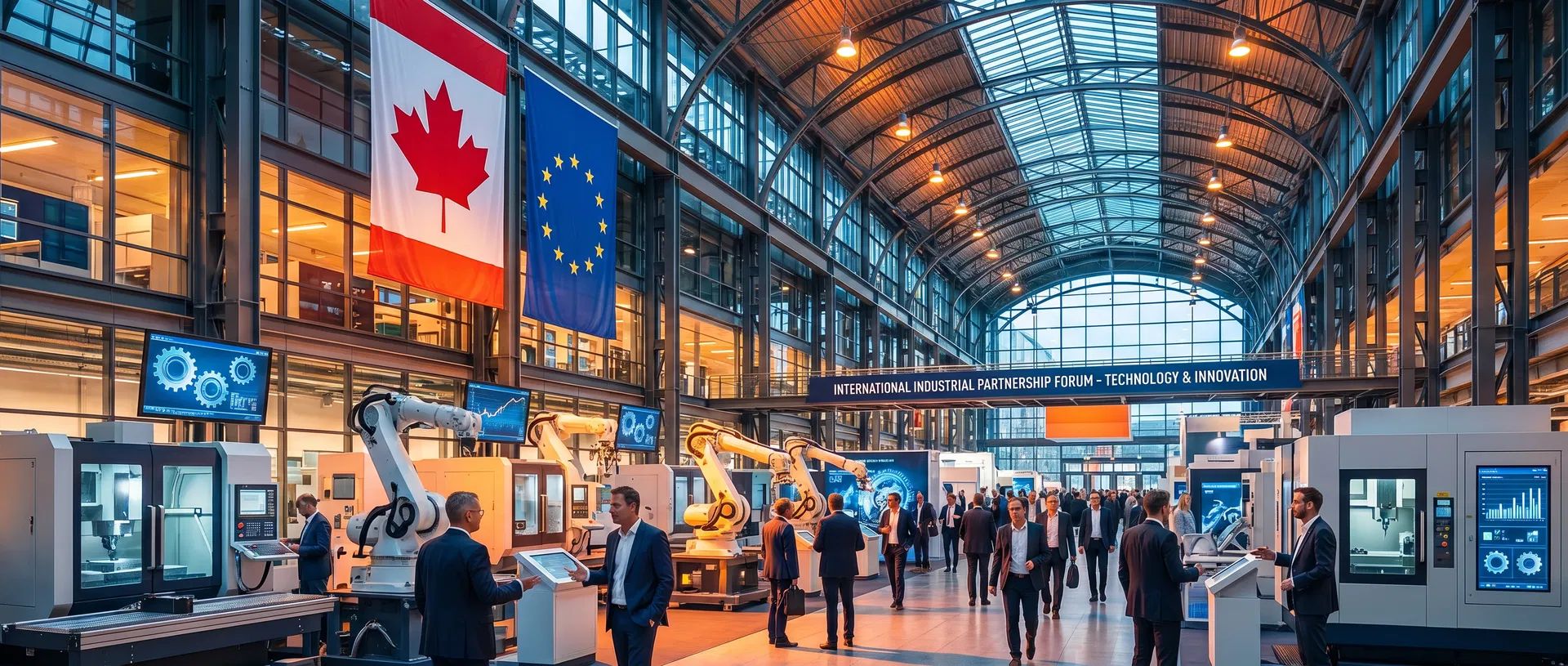
On April 20, 2026, Industry Minister Mélanie Joly stood at the Hannover Messe — the world's largest industrial trade fair, attended by over 200,000 visitors and 6,500 exhibitors — and announced $25 million in new federal funding through NGen (Next Generation Manufacturing Canada), leveraged by $38 million from industry partners, to launch 14 advanced manufacturing projects across the country.
This is exactly the kind of initiative that the Vox Block system was designed for. NGen's Advanced Manufacturing Technology Program is built to strengthen Canadian manufacturing competitiveness, generate global commercial opportunities, and develop a modern workforce. The Vox Block factory — automated, intermodal-ready, producing a carbon-negative building material from Canadian agricultural waste — is advanced manufacturing in its purest form.
Radford Sovereign Shield is actively pursuing NGen funding and similar federal programs to establish the first Vox Block manufacturing hub at CentrePort Canada in Winnipeg. We believe this project aligns precisely with the government's stated goals: import substitution, trade diversification, supply chain resilience, and carbon reduction.
Why Europe Matters
While the United States has imposed a 45% tariff on Canadian lumber and 50% on steel and aluminum — effectively weaponizing the materials we need to house our own people — the European Union has done the opposite. Under CETA, 98% of tariffs between Canada and the EU have been eliminated. Canadian manufactured goods enter European markets duty-free.
Germany is already Canada's largest export market in the EU. Bilateral trade exceeded $38 billion in 2025. In February 2026, Canada and Germany signed a joint declaration to deepen collaboration in key industrial sectors. And for the first time in 2026, Canada brought dual-use defence applications to Hannover Messe — exactly the category the Vox Block occupies as both civilian housing and military shelter.
Over the past two years, Canadian companies participating in Hannover Messe have driven more than $336 million in trade and investment. Prime Minister Carney has set a target to double non-US exports within a decade. The Vox Block system — exportable by container, tariff-free under CETA, and aligned with EU building codes that already favour non-combustible mineral construction — is a natural fit for that ambition.
The European Advantage
Your Home Is a Carbon Bank.
The Vox Block doesn't just reduce emissions — it sequesters carbon permanently. That sequestration has measurable, verifiable, financial value. And in the emerging world of climate-linked finance, that value belongs to the homeowner.
The Voluntary Carbon Account
When you build with Vox Blocks, you are not just "reducing" emissions — you aresequestering them. The blocks trap CO₂ permanently within their mineral matrix. That sequestered tonnage can be verified and tokenized.
Private platforms like Puro.earth and Isometric are already issuing CO₂ Removal Certificates (CORCs). As a homeowner, your house becomes a Carbon Bank. You hold a "Net Negative" status for your property — credits that can be held, sold to corporations meeting net-zero targets, or leveraged for financial benefits.
Green ID & Climate-Linked Finance
Banks are moving toward climate-linked finance. A verified carbon-negative home triggers the "Super-Prime" collateral status that lenders are beginning to recognize.
CMHC's Eco Improvement program already offers up to 25% refund on mortgage insurance premiums for energy-efficient homes. As carbon verification systems mature, your home's "green ID" becomes a passport to lower interest rates, reduced insurance premiums, and preferential tax treatment. This is not a tracking device — it is a financial weapon that the homeowner uses to demand discounts.
Taxpayer Proof of the Future
Building "Carbon Labels" are coming — like the energy ratings on appliances today. When they arrive, wood-frame homeowners may face a carbon penalty as their structures degrade, off-gas, and require energy-intensive renovation or replacement every 25-30 years.
The Vox Block homeowner's account stays green. You are holding a100-year mineral asset that has already paid its carbon debt. While others face rising compliance costs, your home is proof that you are part of the solution — and that proof has financial value that compounds over time.
A Financial Tool, Not a Surveillance System
The fear of a "social credit" style carbon account is a real concern in Canadian politics. But for a homeowner using high-performance materials, the carbon account is the opposite — it is a financial defensive weapon. It is the proof you need to tell the bank, the insurer, and the tax office: "My home is helping the planet, so you owe me a discount." By building with a material that scrubs the earth, you are not a participant in someone else's system — you are one of the few people who will actually profit from it.
One Container.
Three Homes.
The Vox Block is engineered to the exact dimensions of a standard 40-foot shipping container. This is the unit of measurement that makes the system scalable, exportable, and quantifiable.
| Scale | Containers | Homes | People Housed | Annual CO₂ Saved |
|---|---|---|---|---|
| Single Shipment | 1 | 2–3 | 8–12 | 20–35 tonnes |
| Monthly Output | 83 | 215+ | 860+ | 1,700+ tonnes |
| Annual Factory | 1,000 | 2,600+ | 10,400+ | 20,000+ tonnes |
| 5-Year Program | 5,000 | 13,000+ | 52,000+ | 100,000+ tonnes |
| National Network (5 hubs) | 5,000/yr | 13,000+/yr | 52,000+/yr | 100,000+ tonnes/yr |
Factory → Rail → Ship → Site. The container never needs to be unpacked until it reaches the building site.
The same container ships to a Manitoba reserve, a NATO base in Norway, or a housing project in Germany — all tariff-free under CETA.
The blocks are dimensioned to fill a container with almost zero wasted space. Every shipment is a full shipment.
The Reception Is Ready.
A paradigm shift in building materials will face scrutiny from every direction. We welcome that. Here is an honest assessment of how this project will be received — and where the friction will be.
Political Reception
On April 14, 2026, Prime Minister Carney and Premier Kinew signed the historic"One Project, One Review" agreement to cut red tape for major infrastructure in Manitoba. They are actively looking for shovels-in-the-ground projects that prove the federal-provincial partnership works.
Premier Kinew is pushing the Manitoba Crown-Indigenous Corporation (MCIC). A hemp-sourced, Indigenous-partnered manufacturing plant in Brady is a direct fulfillment of his primary economic mandate. The political timing could not be better.
Financial Reception
Banks and insurers are retreating from traditional wood-frame assets because the math no longer works in a climate-catastrophe era. 2024 and 2025 were the costliest years in Canadian history for insured losses. Mortgage risk has more than doubled.
Lenders won't just "accept" the Vox Block — they will eventually demand it. An insurance CEO doesn't care about the hemp story. They care about"Loss-Probability Zero" data. If you can prove the extinguishment of risk, you are solving their existential crisis.
Public Reception
Canadians are house-obsessed and wood-frame-defaulted. Some will hear "hemp" and think of counter-culture. That is why we use precise language: "Petrified Mineral Matrix" and "Non-Combustible Stone." Because that is what it is.
The first question every homeowner asks: "Is it cheaper?" The honest answer: it may not be cheaper to build yet. But it is exponentially cheaper to own. The TDS Compression argument — lower energy, lower insurance, zero maintenance — is the tool that wins the public over. When the monthly cost of living in the home is half that of the neighbour's, the conversation changes.
The Status Quo Lobby
The traditional construction industry is a massive beast — softwood lumber and conventional builders have spent 100 years perfecting the wood-frame model. They will point to "market-readiness" and "training gaps" for trades.
Our counter: the Vox Block is "Industrialized Construction" that solves their labour shortage. We are not asking tradespeople to learn a new craft. We are giving them a modular system that locks together faster than they can frame a wall. The blocks don't replace builders — they make builders faster, and they make buildings permanent.
The government needs this project to hit their 2030 targets. The banks need it to de-risk their loan books. Indigenous Nations need it to build a sovereign economy. The people holding the $31 billion checkbooks — DND, CMHC, and the Strategic Innovation Fund — are the ones who are already leaning in. The friction is real, but the momentum is stronger.
The People Who Need This.
These are the voices of the people this system is designed to serve — Indigenous leaders, bankers, insurance executives, politicians, farmers, and municipal leaders. Each one faces a crisis that the Vox Block system directly addresses.
The Nation We Are Becoming.
Canada is at an inflection point. The old assumptions — that we would always trade freely with our southern neighbour, that lumber would always be cheap, that energy would always be abundant, that housing would always be affordable — have all been challenged in the span of a few years. Tariffs. Climate events. A housing crisis that has locked an entire generation out of homeownership. A defence posture that suddenly matters again.
But in that disruption is an opportunity that few countries on earth are positioned to seize. Canada has the raw materials — hemp, limestone, pozzolan — growing in and under its own soil. It has the manufacturing expertise. It has CETA and a deepening alliance with Europe. It has the Arctic, and the northern infrastructure that will matter more with every passing decade. It has a Prime Minister who has publicly committed to doubling non-US exports and building a more resilient, diversified economy.
The Vox Block system is not the only answer. But it is one of the projects that Canada requires to become the global power it is obviously becoming. A country that can house its own people in structures that last a century, that barely need heating, that are fireproof and mould-proof and earthquake-resistant — and that can export those structures to allies around the world — is a country that has solved something fundamental. Not just a housing problem. An energy problem. A sovereignty problem. A humanitarian problem.
This is the Canadian path. And we are looking for the people who want to walk it with us.
We Are Looking for You.
Radford Sovereign Shield is actively seeking grants, private investment, and strategic partnerships. We are not looking for everyone. We are looking for people and organizations who understand what is at stake and want to be part of the solution.
Who We're Seeking
Private Investors
Individuals and funds who see the convergence of housing, energy, and sovereignty as the investment thesis of the decade. This is infrastructure that appreciates over a century.
Industrial Partners
Companies with carbon emissions or waste heat who want to turn environmental liability into productive partnership. Your waste stream becomes our manufacturing energy.
Government & Municipalities
Federal, provincial, and municipal leaders who need affordable, permanent housing solutions and want to reduce their community's carbon footprint simultaneously.
Politicians & Policy Makers
Elected officials who understand that housing policy, energy policy, and industrial policy are the same policy — and who want a made-in-Canada solution to prove it.
Industry Leaders & Visionaries
Individuals in construction, energy, agriculture, logistics, and defence who see the potential for a sovereign building system to reshape their sector.
Humanitarian Organizations
Groups working on Indigenous housing, disaster relief, veterans' housing, and affordable housing who need a building system that actually solves the problem permanently.
Start the Conversation
Tell us who you are and how you'd like to be involved. We respond to every inquiry within 48 hours.
NGen Advanced Manufacturing
Federal funding through Canada's Global Innovation Cluster for advanced manufacturing
CMHC Housing Innovation
Canada Mortgage and Housing Corporation programs for innovative housing solutions
Manitoba Green Fund
Provincial programs supporting sustainable manufacturing and carbon reduction
Private Sector Investment
Strategic investment from aligned individuals and funds who share our vision