Arctic Infrastructure Fund (Stream 2) — Application deadline: June 5, 2026
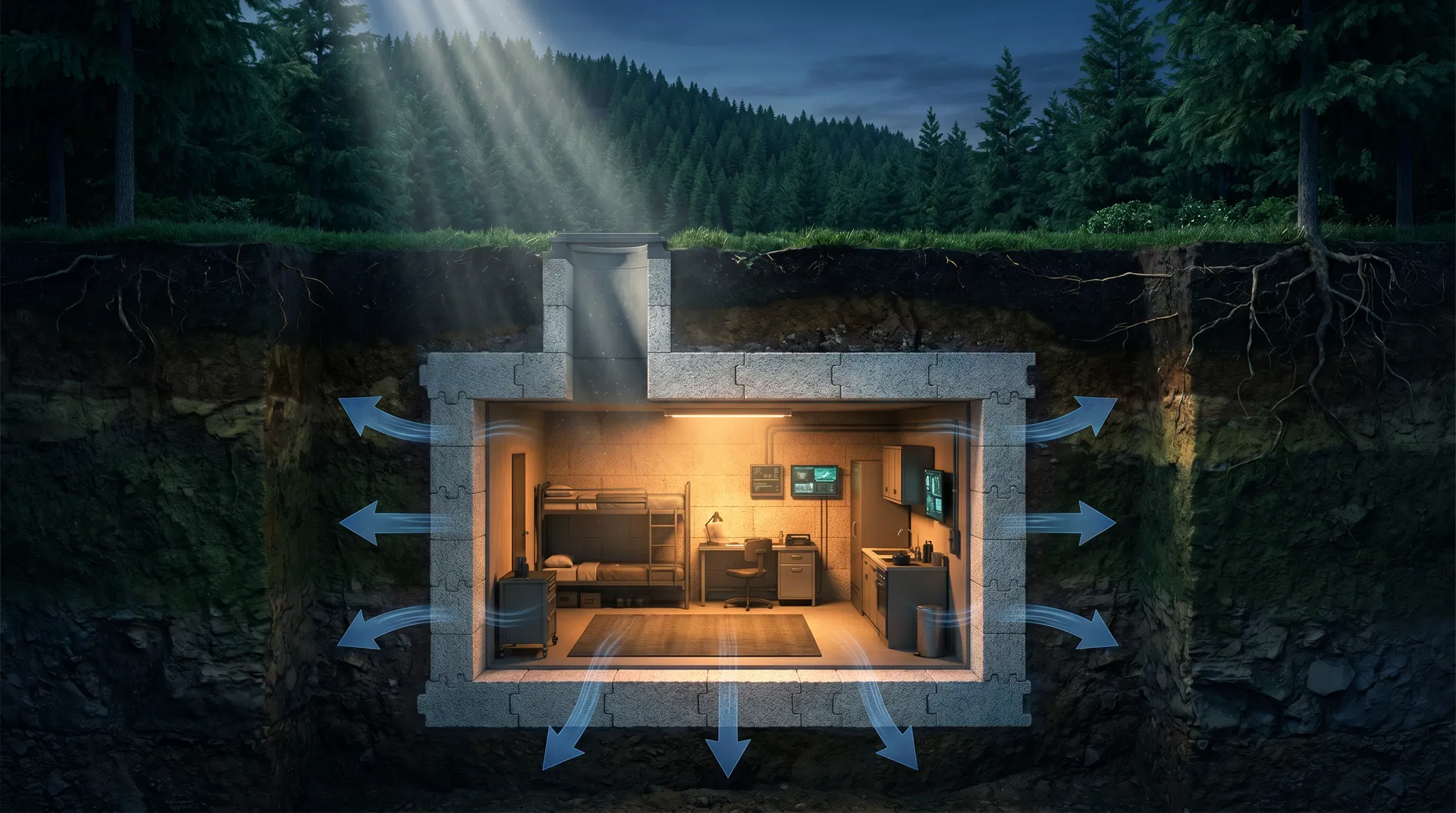
The Breathing
Bunker
22-inch Vox Block walls with alternating course bond and a controllable positive-pressure breathing system. Not a steel tube buried in a hole — a Vox Block monolithic mass wall that actively defends against fire, moisture, contamination, and thermal extremes.
Steel Bunkers Are
Fundamentally Flawed
The conventional underground shelter industry sells corrugated galvanized steel tubes — essentially repurposed culvert pipe — at prices ranging from $150,000 to $475,000. These structures have zero insulation value (steel conducts heat 50 W/m·K), require continuous mechanical dehumidification, and corrode in soil at rates that limit their functional lifespan to 28–75 years depending on ground conditions.
Every welded joint is a potential point of failure. Steel resonates and amplifies sound (STC 25–30). There is no fire rating — steel loses 50% of its yield strength at just 1,112°F. And the entire structure relies on a waterproof coating that degrades over time, leaving occupants dependent on sump pumps and dehumidifiers for basic habitability.
Positive-Pressure
Breathing Wall
The Vox Block wall is not airtight — it is vapor-permeable by design. By introducing controllable positive pressure on the interior, the walls breathe outward continuously. This transforms a passive building element into an active defence system that can be tuned from standby to emergency mode in seconds.
OFF — Passive
Wall breathes naturally. Hemp-lime's inherent vapor permeability maintains indoor humidity between 40–70% RH without any mechanical system. The alkaline matrix (pH 12+) prevents mold and biological growth passively.
Hemp-lime is classified as an "excellent" moisture buffer (MBV > 2.0 g/m²·%RH). The lime binder maintains pH 12+, creating an environment where mold and bacteria cannot survive.
Head-to-Head
Comparison
Every figure below is drawn from published ASTM test results, peer-reviewed journal articles, or manufacturer-verified data. No assumptions. No marketing claims.
12" hempcrete wall withstood 1,700°F for 60 minutes. Unexposed face remained at ambient temperature. US Army $1.9M SBIR funded. Tested at Intertek, York, PA.
Craig & Grinham (2017, Energy and Buildings, 90 citations) proved air flowing through porous materials at 1 mm/s reduces effective heat transmission by 98.5%.
Lime-based construction has survived millennia. The binder continues to carbonate over time, increasing compressive strength as it absorbs atmospheric CO₂.
22-Inch Rotated Wall
Alternating Course Bond
By rotating the Vox Block 90 degrees, the wall thickness increases to 22 inches — delivering bunker-grade mass without custom formwork or poured concrete. Each course of blocks runs perpendicular to the course below, creating a running bond pattern with no through-joints.
Because the blocks are divisible amongst themselves — their interlocking geometry provides mechanical keying between courses — the wall behaves as a single continuous monolithic mass rather than an assembly of discrete units. There is no single point of failure. Compare this to a welded steel assembly where one defective weld can compromise the entire structure.
No Crane Required
Individual blocks are hand-portable. No oversize permits, no heavy equipment mobilization, no specialized rigging crew.
No Welding
Mortarless interlocking system eliminates welding — and the single-point failure risk that comes with every weld in a steel bunker.
Squad-Level Assembly
Designed for 30-minute Standard Operating Procedure. A standard masonry crew of 3–4 can erect walls in days, not weeks.
Carbon-Negative
Each block sequesters 3.47 kg of CO₂. A 500 sq ft bunker stores approximately 8 tonnes of carbon permanently — the structure pays back its environmental cost.
Request a Technical Briefing
For military procurement officers, emergency management agencies, government partners, and private clients seeking next-generation shelter infrastructure. We provide detailed technical packages including full engineering specifications, published test data, and project-specific cost analysis.
DND, DRDC, NATO, allied forces procurement
Provincial/federal emergency shelters, disaster response
High-net-worth individuals, corporate continuity
[email protected] | 604-813-3735