Arctic Infrastructure Fund (Stream 2) — Application deadline: June 5, 2026
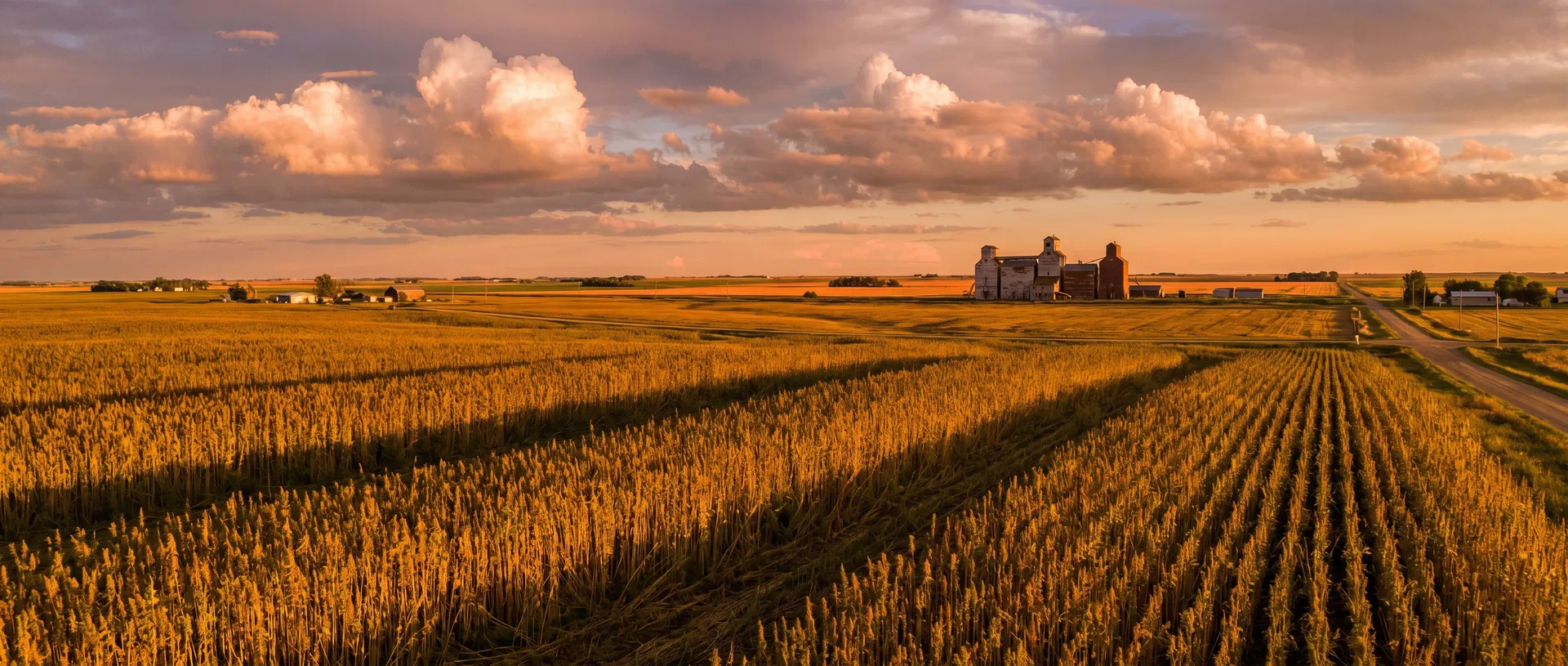
From Prairie Soil
to Sovereign Stone
Every Vox Block is 100% Canadian-traceable. Hemp hurd from Indigenous prairie farms. Lime from Manitoba quarries. Pozzolan from Western Canadian suppliers. No foreign dependencies. No tariff vulnerabilities. A supply chain as sovereign as the product.
Four Inputs.
Zero Imports.
The Vox Block formula requires exactly four raw materials — all sourced within a 500-kilometre radius of CentrePort Manitoba. This is not a supply chain. It is a supply circle, and every link in it is Canadian.
Hemp Hurd
The woody inner core of the industrial hemp stalk — a carbon-negative agricultural byproduct that forms the structural aggregate of every Vox Block.
Hydrated Lime
High-calcium limestone from Manitoba's Interlake quarries, calcined and hydrated to create the mineral binder that petrifies around hemp hurd particles.
Pozzolan
Silica fume and natural pozzolanic additives that accelerate the lime carbonation process and increase compressive strength without Portland cement.
Water
Clean municipal water from Winnipeg's award-winning Shoal Lake Aqueduct system — one of the purest municipal water supplies in North America.
Hemp Hurd:
The Prairie's Hidden Aggregate
Industrial hemp has been commercially grown on the Canadian prairies since the late 1990s, when Manitoba became the epicentre of Canada's hemp revival. Today, approximately 50,000 acres of industrial hemp are cultivated annually across the prairie provinces, with Manitoba consistently leading national production.
The hemp hurd — the woody inner core of the stalk — is the primary aggregate in every Vox Block. After decortication separates the valuable bast fibre from the stalk, the hurd has traditionally been treated as agricultural waste. Only about 15% of harvested hemp fibre is currently processed; the rest is left to decompose in the field. Vox Block transforms this waste stream into the backbone of sovereign infrastructure.
Hemp grows to maturity in 90 to 120 days, requires no pesticides, minimal irrigation, and sequesters approximately 1.62 tonnes of CO₂ per tonne of dry hemp stalk. Each Vox Block therefore begins its life as a carbon sink before it ever reaches a construction site.
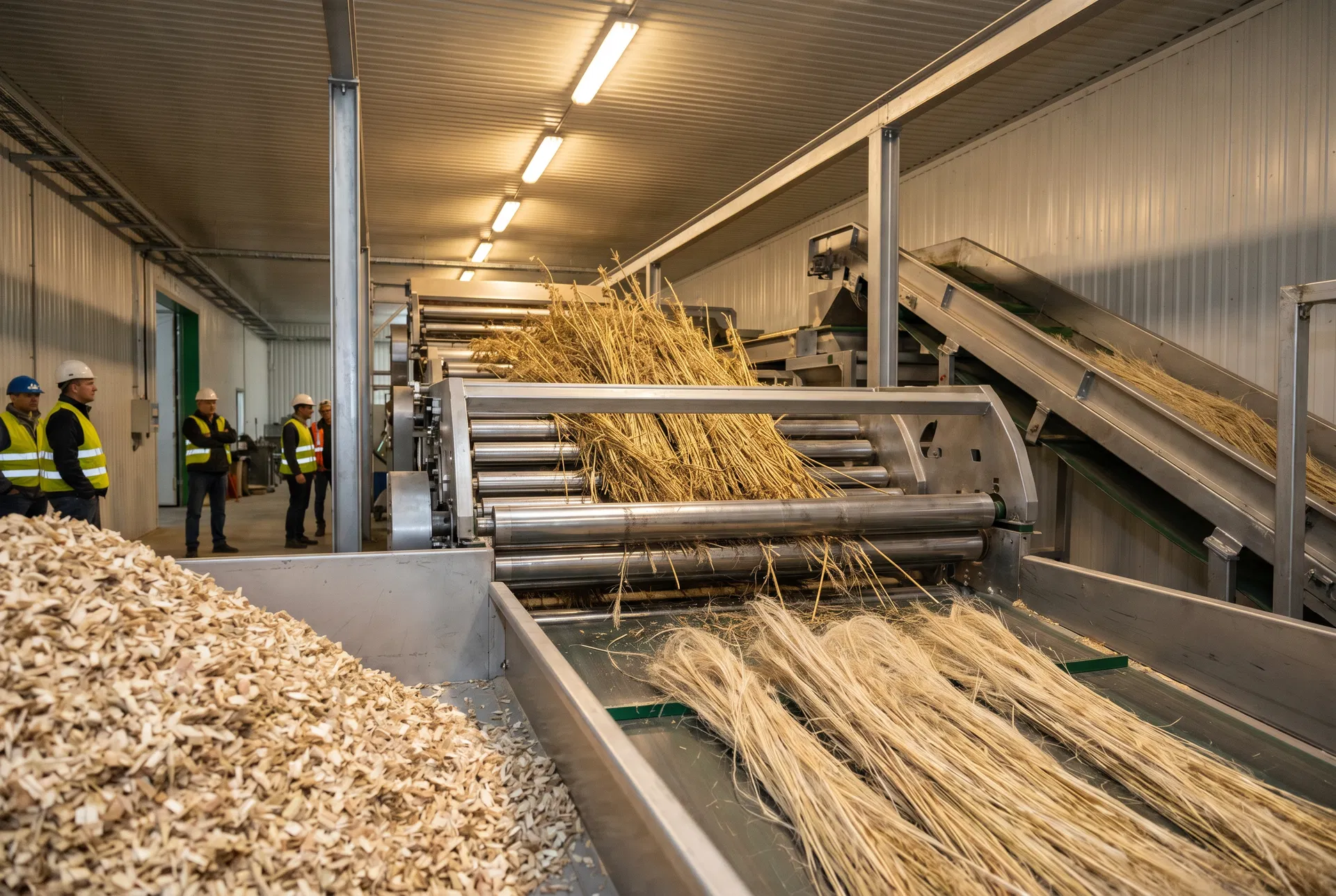
Steel rollers separate the woody hurd (left) from the long bast fibres (right). The hurd is then graded, dried, and shipped to the Vox Block factory as the primary aggregate.
Hemp Agriculture.
The Full Picture.
We believe in transparency. Hemp is not a miracle crop with zero challenges — it is a genuinely superior agricultural option with real advantages and real limitations. Understanding both is essential for anyone considering this supply chain. Here is the honest assessment.
The Advantages
No Pesticides Required
Almost all hemp varieties are naturally resistant to insect pests. The plant produces terpenes that repel most predators, and its rapid canopy closure (6-8 weeks) outcompetes weeds without herbicides. The Stroud Water Research Center confirms hemp can be grown with zero synthetic pesticide applications.
Minimal Fertilizer Needs
Hemp's deep taproot — extending up to 3 feet — accesses nutrients from deeper soil profiles that shallow-rooted crops cannot reach. While hemp does require nitrogen, it can source much of it through crop rotation with legumes and organic matter, dramatically reducing the need for synthetic nitrogen fertilizers that contaminate waterways.
38% Less Water Than Cotton
A peer-reviewed comparative study found hemp requires 38% less water, has a 60% lower water footprint, 84% lower irrigation requirement, and 91% lower irrigated water footprint than cotton. Hemp needs only 250-450mm of water per growing season — in Manitoba's climate, rainfall alone is often sufficient.
Superior Carbon Sequestration
For every tonne of hemp grown, 1.63 tonnes of CO₂ are removed from the atmosphere — more than any commercial crop on earth and significantly more than trees of comparable biomass. When that carbon is locked into a Vox Block, it becomes permanent sequestration for 100+ years.
Soil Regeneration
Hemp's deep taproot breaks up compacted soil, improving water infiltration and aeration. The root system produces compounds that increase soil microbial diversity. Hemp is an excellent rotation crop — farmers who grow hemp before wheat or canola consistently report improved yields in the following season.
Bioremediation Capability
Hemp plants can grow in contaminated soil without loss in productivity, absorbing heavy metals and toxins into their tissues. Hemp was used to remediate soil at Chernobyl following the 1986 nuclear disaster. This means hemp can rehabilitate degraded agricultural land while simultaneously producing useful fibre.
The Challenges
Processing Infrastructure Gap
The single biggest challenge facing hemp agriculture in Canada is the lack of decortication and fibre processing facilities. Iowa State University Extension notes there are currently few organized hemp markets or processors in most regions. Multiple US processors filed bankruptcy in 2020. This is precisely the gap that Vox Block's factory model fills — creating guaranteed demand and processing capacity.
Vox Block factories create the missing processing infrastructure, providing guaranteed offtake contracts for prairie hemp growers.
Nitrogen Demand
Hemp is what farmers call a 'nitrogen hog' — it requires significant nitrogen to reach full growth potential. While hemp can source nitrogen from organic matter and crop rotation, large-scale monoculture production may still require some fertilization. The key difference: hemp's nitrogen needs can be met through organic methods (compost, manure, legume rotation) rather than synthetic fertilizers.
Organic nitrogen sources and crop rotation with legumes can meet hemp's needs without synthetic fertilizers entering the watershed.
Early-Stage Weed Vulnerability
Hemp is vulnerable to weed competition during its first 3-4 weeks before the canopy closes. Without herbicides, farmers must rely on mechanical cultivation, dense planting, or careful seedbed preparation. Once the canopy closes, hemp outcompetes virtually all weeds — but that initial window requires attention and skill.
Dense planting strategies and mechanical cultivation during the 3-4 week window eliminate the need for chemical herbicides.
Specialized Harvesting Equipment
Hemp fibre wraps around conventional combine parts, requiring specialized harvesting equipment that most Canadian farms don't currently own. Drying and storage also present challenges — moisture management is critical to prevent mould in stored hemp bales. Equipment availability in North America remains limited.
As the Vox Block supply chain scales, equipment cooperatives and mobile decortication units can serve regional growing clusters.
Market Volatility & Regulatory Complexity
The Hemp Benchmarks price index fell 84% between July 2019 and January 2020. THC testing requirements mean crops exceeding 0.3% must be destroyed at the farmer's expense. Varying provincial and federal regulations create compliance burdens. The confusion between hemp and marijuana persists in public perception and banking.
Long-term offtake contracts with Vox Block provide price stability. Industrial fibre hemp varieties consistently test well below THC limits.
Stigma & Banking Challenges
Despite legalization, hemp farming still faces social stigma and practical barriers. Some banks and insurance companies remain reluctant to serve hemp operations due to cannabis association. This is changing, but it remains a real friction point for farmers considering the switch from conventional crops.
As industrial hemp for construction gains mainstream recognition, financial institutions are increasingly comfortable with the sector.
Hemp is not perfect. No crop is. But when you compare it honestly against the alternatives — cotton that drinks water and demands pesticides, softwood lumber that takes 40 years to grow and burns in minutes, concrete that accounts for 8% of global CO₂ emissions — hemp stands apart. Its challenges are logistical and infrastructural, not fundamental. The Vox Block factory model solves the biggest one: it creates the processing infrastructure and guaranteed market that hemp farmers have been waiting for since legalization.
The real question is not whether hemp has challenges. It does. The real question is whether we can afford to keep building with materials that poison our water, burn in our fires, and depreciate in a single generation. We cannot.
What Pesticides & Fertilizers
Are Doing to Our Water.
Agriculture Canada's own data confirms it: the risk of water contamination by pesticides on Canada's farmland has increased over time. The chemicals we spray on conventional crops don't stay in the field. They run off into our streams, rivers, lakes, and groundwater — the same water our families drink.
Lake Winnipeg — Manitoba's most important body of water and the 10th largest freshwater lake on Earth — is choking. Nitrogen and phosphorus from agricultural fertilizer runoff have triggered massive algae blooms that threaten drinking water, fisheries, and the entire lake ecosystem. The federal government has identified agricultural runoff as the primary driver.
Every acre of prairie farmland that switches from conventional grain crops to industrial hemp is an acre that stops sending pesticides and synthetic fertilizers into the Lake Winnipeg watershed. This is not theoretical. This is hydrology.
Hemp requires zero pesticides. Not reduced pesticides. Not fewer pesticides. Zero. The plant's natural terpene production and rapid canopy growth make it inherently resistant to the pests that force conventional farmers to spray.
Hemp's deep taproot — extending up to 3 feet into the soil — does something remarkable: it improves water infiltration rather than contributing to surface runoff. Water that infiltrates the soil is naturally filtered. Water that runs off the surface carries chemicals directly into streams and rivers.
A 2026 study published in Sustainability (Wojtasik, 2026) even demonstrated that hemp waste can be used as a filtration medium to improve surface water quality — meaning hemp doesn't just avoid polluting water, it can actively clean it.
The connection is direct: Every Vox Block factory that opens creates demand for thousands of acres of hemp. Every acre of hemp replaces an acre of pesticide-sprayed, fertilizer-drenched conventional agriculture. Every acre that switches is an acre that stops poisoning our water. This is not an environmental talking point. This is a supply chain that heals the land it touches.
Indigenous Farmers.
Sovereign Partners.
Vox Block's supply chain is not just Canadian — it is Indigenous-partnered. We source hemp directly from First Nations farming operations across the prairies, creating economic opportunity on reserve lands while honouring the deep agricultural knowledge that has sustained these communities for millennia.
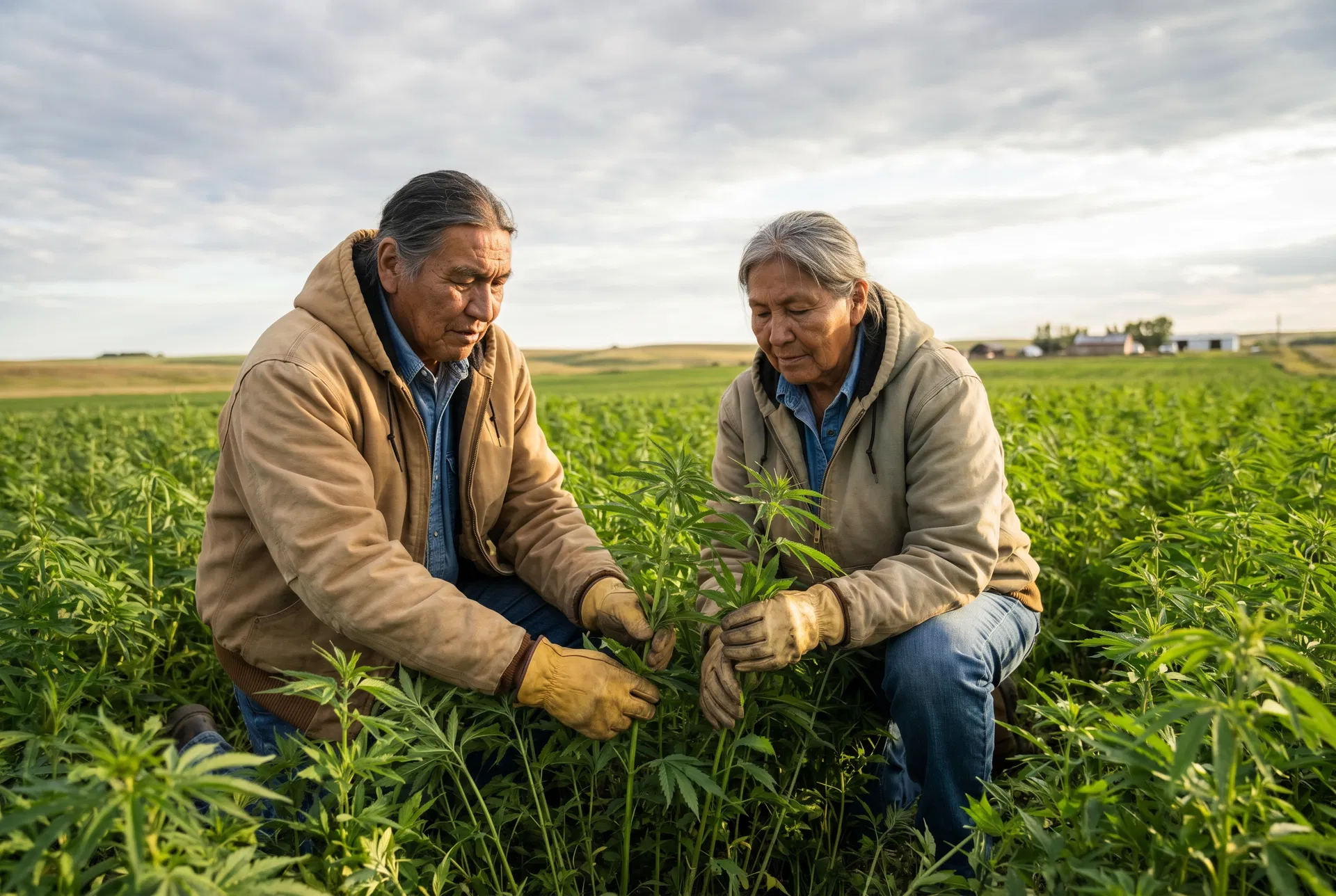
Nearly 80% of Indigenous farmers in Canada identify as Métis, with the largest concentrations farming in Alberta, Saskatchewan, and Manitoba — the same provinces that form the Vox Block hemp supply corridor. This is not coincidence. It is alignment.
Direct Procurement Model
Vox Block contracts directly with First Nations farming cooperatives — no middlemen, no commodity brokers. This ensures fair pricing, predictable demand, and long-term economic stability for Indigenous growers.
Regenerative Agriculture
Hemp is a regenerative crop that restores soil health, requires no pesticides, and breaks disease cycles for subsequent grain crops. Indigenous farmers are leading this agricultural renaissance across the northern plains.
Economic Sovereignty
Every tonne of hemp hurd purchased from Indigenous farms generates revenue that stays on reserve. This is reconciliation measured not in words but in purchase orders — a structural commitment to Indigenous economic self-determination.
Training & Capacity
Vox Block partners with tribal colleges and agricultural institutes to train Indigenous growers in fibre hemp cultivation, organic certification, and regenerative land management practices.
Siksik'a Nation
Blackfoot nation — Canada's second-largest reserve at 270 square miles. Grew 130 acres of hemp in partnership with Fresh Hemp Foods (Manitoba Harvest). Expanding to fibre varieties for construction applications.
Frog Lake First Nation
Askiy Hemp LP initiative planned cultivation on up to 125,000 acres. $5M federal PrairiesCan investment for Indigenous-owned hemp processing plant in Elk Point, Alberta.
Anishinaabe Agriculture Institute
Founded by Winona LaDuke. Training tribal farmers in regenerative organic fibre hemp. Building an intertribal hemp cooperative spanning multiple nations across the northern plains.
Peguis First Nation
Manitoba's largest First Nation by population. Actively developing agricultural diversification programs including industrial hemp, positioned within the Vox Block supply radius.
Indigenous Hemp & Cannabis Cooperative
New intertribal cooperative organizing a network of Indigenous hemp growers across the prairies. Focused on seed banking, technical support, and value-added production.
Canadian Indigenous Hemp Consortium
National organization coordinating Indigenous participation in Canada's hemp industry. Advocating for regulatory frameworks that support First Nations agricultural sovereignty.
Nation-to-Nation Industrial Partnership
Radford Sovereign Shield is not seeking Indigenous communities as suppliers alone. We are seeking them asequity partners. The vision is a 25-51% Indigenous ownership stake in the manufacturing operation — transforming the project from a private company seeking a grant into aNation-to-Nation industrial partnership that is, in the current political environment, essentially un-declinable for federal funding.
The First Nations Major Projects Coalition (FNMPC) conference (April 29 – May 1, 2026) represents a critical opportunity to formalize these relationships. The FNMPC has facilitated over $31 billion in Indigenous-led resource projects. Their framework for equity participation in major infrastructure aligns precisely with the Vox Block manufacturing model: Indigenous-sourced raw materials, Indigenous equity in the factory, Indigenous employment in production, and Indigenous communities as the first recipients of the finished homes.
Premier Kinew's Manitoba Crown-Indigenous Corporation (MCIC) — announced as his flagship economic initiative — provides the provincial mechanism. The federal "One Project, One Review" agreement signed April 14, 2026 provides the regulatory pathway. The Vox Block provides the product. What remains is the handshake.
Manitoba Limestone.
Western Canadian Pozzolan.
The mineral binder that transforms loose hemp hurd into permanent stone comes from Manitoba's own geological heritage — limestone quarries that have been operating since the 1880s, and pozzolanic additives from Western Canadian industrial suppliers.
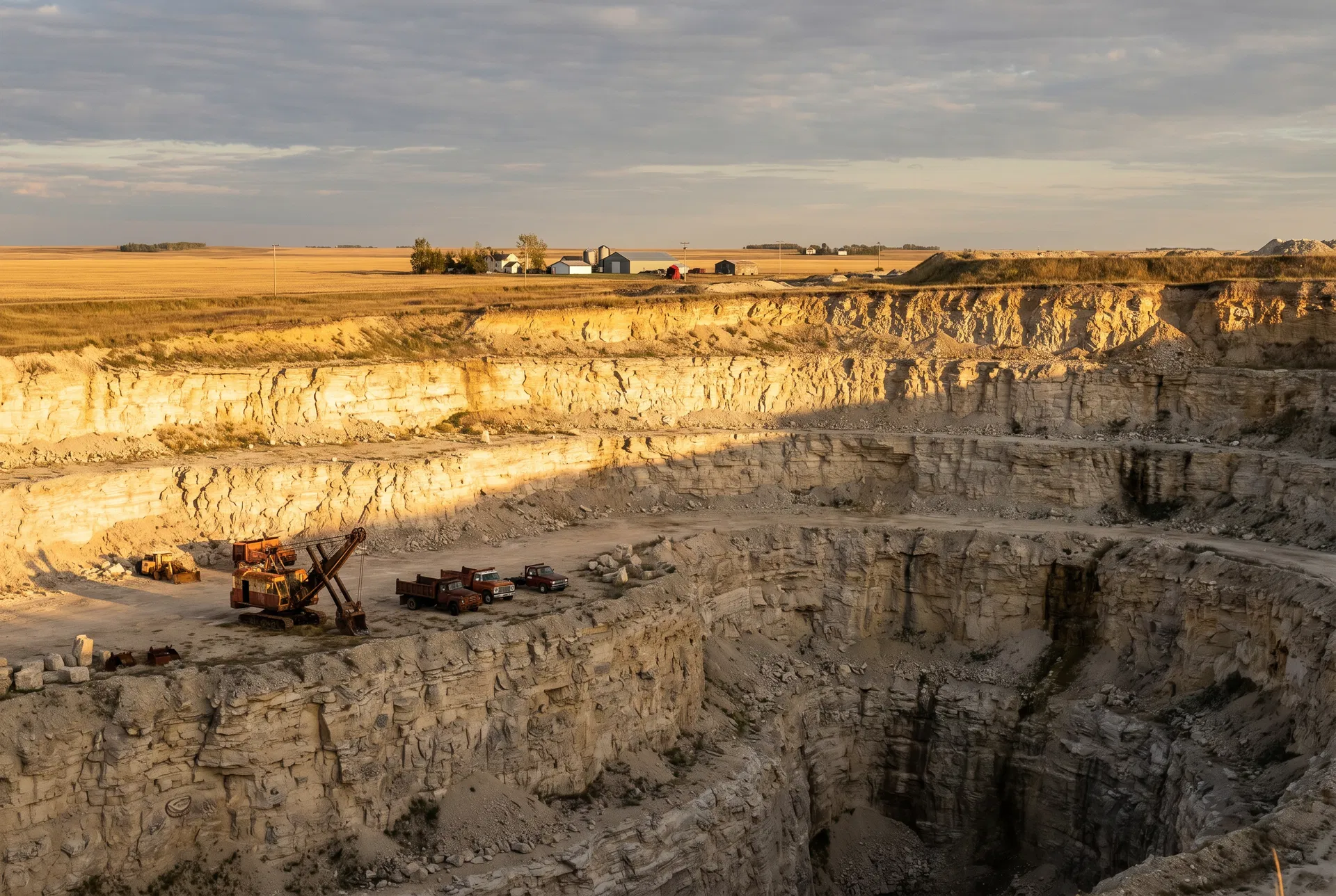
Hydrated Lime
Manitoba sits atop one of the richest limestone formations in North America. The Interlake region — stretching from Stonewall to Garson to Steep Rock — has produced high-calcium limestone since the 1880s. This same geological resource that built Winnipeg's Parliament buildings now mineralizes Vox Block.
Pozzolanic Additives
Pozzolans are silica-rich materials that react with calcium hydroxide (lime) in the presence of water to form cementitious compounds. In the Vox Block system, they accelerate the carbonation process and increase compressive strength — all without Portland cement, which accounts for 8% of global CO₂ emissions.
Canada's largest densified silica fume supplier. A byproduct of silicon and ferrosilicon alloy production — an industrial waste stream repurposed as a high-performance pozzolanic additive. Particle size 100x finer than Portland cement.
Manitoba-based supplier of silica sand and non-silica abrasives serving Manitoba, Saskatchewan, Alberta, and Northwestern Ontario. Local sourcing minimizes transportation emissions and ensures supply chain resilience.
Western Canada's volcanic geological history provides natural pozzolanic deposits. These materials have been used in concrete since Roman times (the Pantheon's dome is pozzolanic concrete) and offer a zero-carbon alternative to synthetic additives.
Portland cement production accounts for approximately 8% of global CO₂ emissions — more than the entire aviation industry. By using a lime-pozzolan binder system instead, every Vox Block avoids this carbon burden entirely while achieving superior thermal and acoustic performance. The lime binder actually re-absorbs CO₂ as it cures, making the mineralization process carbon-negative.
The Sovereign
Manufacturing Process
Six steps transform a prairie hemp stalk into a permanent, carbon-negative building block. Every step occurs on Canadian soil, using Canadian energy, operated by Canadian workers.
Harvest & Field Retting
Hemp stalks are cut at maturity (90–120 days) and left in the field for 2–4 weeks. Natural microbial action loosens the bast fibre from the woody hurd core — a process called retting that requires zero energy input.
Decortication
Retted stalks are fed through industrial decorticators — steel roller systems that mechanically separate the long bast fibres from the hurd. The hurd emerges as irregular chips 10–25mm in length, ideal for hempcrete aggregate.
Grading & Drying
Raw hurd is screened to remove dust and oversized particles, then dried to a target moisture content of 12–15%. Consistent particle size and moisture are critical for uniform block density and curing performance.
Transport to CentrePort
Graded hurd is loaded into standard grain hopper cars or covered trucks for transport to the Vox Block factory at CentrePort Manitoba. Maximum haul distance from any prairie source: 500 km by rail.
Mixing & Casting
At the factory, hemp hurd is blended with hydrated lime, pozzolan, and water in precision-controlled mixers. The wet mix is cast into steel moulds under hydraulic pressure, forming dense blocks with consistent R-40 thermal performance.
Carbonation Curing
Cast blocks cure in a controlled environment where waste heat and captured CO₂ from municipal sources accelerate the lime carbonation process. Over 28 days, the lime literally petrifies around the hemp hurd, creating permanent mineral stone.
Every Input.
Every Kilometre. Tracked.
In an era of fractured global supply chains and tariff warfare, the Vox Block supply chain is a strategic asset. Every raw material is traceable to a specific Canadian source. No container ships. No customs brokers. No geopolitical risk.
Agricultural byproduct — currently wasted. Vox Block creates market value for what farmers discard.
Manitoba limestone quarries have operated continuously since the 1880s. Proven 140+ year supply.
Repurposed waste from silicon smelting. Zero virgin extraction required.
One of North America's purest municipal water supplies. Gravity-fed from Shoal Lake, 150 km east.
Symbiotic Hub model — factory absorbs excess thermal energy from municipal waste processing.
Captured industrial CO₂ is fed into the curing process and locked permanently into mineral stone.
"A nation that cannot source its own building materials is not sovereign. It is a tenant."